
‘Justice may be delayed, but it does not die’

International speakers often provide some of the most inspiring moments from the conference podium. And, this year, Shaher Saed proved no exception.
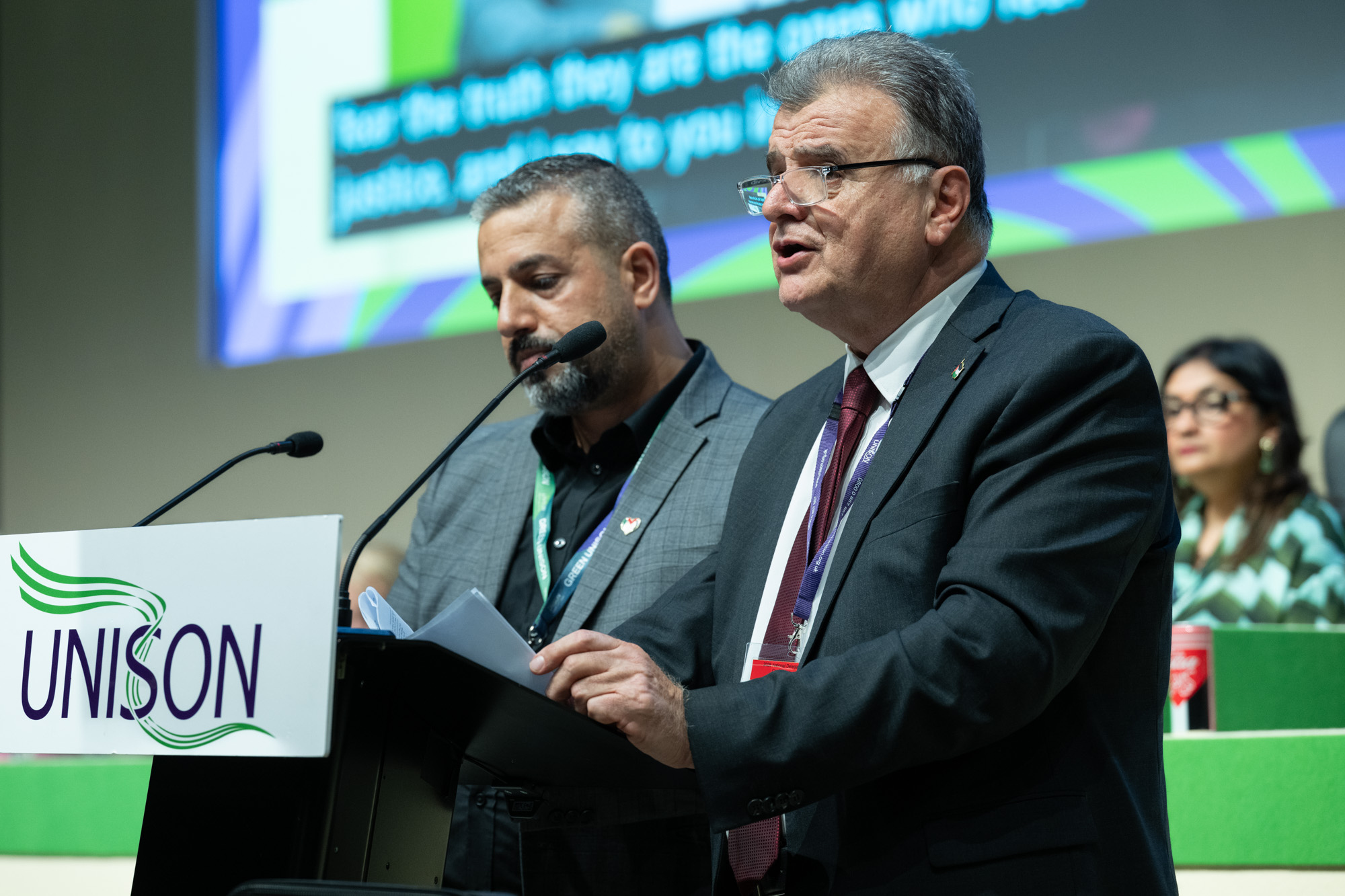
The general secretary of the Palestine General Federation of Trade Unions addressed delegates on Wednesday, with a speech that described the horrors of the genocide in Gaza and the annexation of the West Bank by the Israeli government. But he also reflected the courage, resilience and determination of his people.
Introducing him, UNISON vice president Debbie Rowden said that Palestine had always been an international priority for the union, but “as the Israeli military further intensifies its control of Gaza, and demolitions, displacement, and settlement expansion reach record levels in the West Bank, our solidarity is more important than ever before.”
She also pointed out that Shaher had wanted to attend last year’s conference, only to be prohibited when Israel closed the West Bank’s borders. Now, with a translator beside him, he made up for lost time.
The human price
“I stand before you carrying the voice of a people who continue to struggle for the right to live,” Saed said. “People who seek no privilege and ask for no pity, but demand their natural right to freedom, justice, and human dignity.
“I come to you from Palestine, where the machinery of war continues to claim lives, and where our people in Gaza, the West Bank, and East Jerusalem live under the weight of killing, starvation, destruction, and displacement.
“I come to you from Palestine where a child becomes a number in the news bulletins, where a mother becomes a witness to the loss of her family. And where a worker becomes a human being deprived of livelihood, dignity, and a future.”
He spoke of the “human price beyond comprehension” that has resulted from the Israeli genocide: 80,000 dead in Gaza, including 18,000 children, “children who should have been in schools, not under the rubble”, 12,400 women, “mothers who were killed while caring for their families” and 3,500 elderly, “who died after being exhausted by war and siege.”
There have also been close to 1,000 people killed in the West Bank, while 11,200 Palestinians remain missing. “My comrades, these are not numbers. These are human stories. They have names, dreams, families, and dinner tables that have become empty. These are lives being crushed before the eyes of the world.”
A war with bulldozers
The union leader also spoke about the effects on Palestinians, as workers. “In the West Bank, war is not waged only with weapons. It is also waged with bulldozers, settlements, and land confiscation…. If the war has targeted the Palestinian people, it has also targeted their livelihoods.” Today, 507,000 Palestinian workers are unemployed out of a workforce of 1.5 million, with thousands of families having lost their source of income.
“Palestinian workers have been chased, arrested, and humiliated, and deprived of the most basic human rights. What social justice can exist while workers are denied their livelihoods? And what dignity of labour can be spoken of while a person is punished simply for being a Palestinian?”
A trade unionist for almost 50 years, Saed also the president of the Arab Trade Union Confederation and a member of the governing body of the International Labour Organisation (ILO). And he is looking to the international arena for assistance.
A complaint has been filed with the ILO demanding the restoration of Palestinian workers' rights and compensation for their losses. The Palestinians are also calling on the British and European governments to provide urgent and immediate support to Palestinian workers who have been left without wages and social protection for months, to suspend the arms trade and the trade and partnership agreement with Israel, and to support a two-state solution.
‘Our spirit will not be broken’
And they are calling for workers' funds around the world not to be turned into investments that support settlement and occupation. That’s why, he told the UNISON delegates, “we thank you for campaigning for a comprehensive boycott of investments linked to Israeli settlements, and immediate withdrawal of funds from them. Because workers' money must serve human dignity, not military occupation.”
While describing such brutal hardships, he also gave the conference a sense of the hope and endurance that drives the Palestinian people.
“Despite all this devastation, Palestine continues to give birth to life,” he said. “In Gaza, more than 35,000 children have been born during the months of genocide. It is as though our people are saying to the world, ‘We are here. We remain. And our will and spirit will not be broken’.
“Despite the pain, despite the losses, despite the genocide and ethnic cleansing, our people we will not leave or vanish. We will remain on our land. And we will continue to hold firmly to our right to freedom and dignity, because we are a people who know that rights do not disappear, and that justice may be delayed, but it does not die.”
Finally, Shaher Saed spoke in English for the first time. “Thank you for standing with our people and workers. Long live the unity of the workers around the world. Long live a free Palestine. Free, free, free Palestine.”
In their standing ovation, the delegates also rose in one voice to return his call: free Palestine.
Today (Thursday) conference passed a motion reaffirming its campaign for a permanent ceasefire in Gaza, including the withdrawal of Israeli troops, full access to humanitarian assistance, an end to the blockade and a just peace plan that respects international law and successive UN resolutions, providing for a viable, contiguous Palestinian state alongside Israel.
Proposing the motion, Margaret McKee of the NEC said: “Our freedom is incomplete without the freedom of the Palestinian people.”
More articles like this

News
Young members at national delegate conference
Two young members attend UNISON's national delegate conference
.jpeg?w=1600&v=5564df10-21f4-4752-8d4a-3938f9a6b243&itok=mUeqVO0B)
News
UNISON elects James Anthony as President
James Anthony, formerly UNISON's senior vice president, succeeds outgoing UNISON President Catherine McKenna

News
Angela Rayner: born in Stockport, raised in UNISON
'Better quality jobs – with a stronger voice for people at work – is the solution,' said the former deputy prime minister