
‘Conference, we are in the fight of our lives’

The final morning of UNISON’s national delegate conference was dominated by debates concerning the union’s response to the far right in general, and Reform UK in particular.
Speakers voiced their concern about the wide-ranging threat to public services, but also the incitement to discrimination that affects every corner of British society.
As one member put it: “I’m Black, lesbian and a migrant. Reform UK feels like a direct threat to who I am.”
Moving the motion, ‘Tackling Reform UK’, Debbie Rowden of the national executive council (pictured above) told delegates: “This is potentially one of the most consequential motions of this conference. I do not say that lightly. I say that because Reform UK poses a threat to everything we do, everything we value, everything we stand for, and everything that we are.”
Debbie reminded delegates that Reform UK has pledged to repeal the Employment Rights Act, the Equalities Act, and the Renters Rights Act. It has served notice that it will target public sector pensions. And party leader Nigel Farage has spoken of his belief that he favours a US-style private insurance model over the NHS.
“But of course the threat they pose is not just theoretical, about what they would do in the future, it's also about what they are doing now,” she added. “Where Reform UK wins power in local government, they are already making life difficult for our members and those that rely on services they provide.
“Equality, diversity, and inclusion have been scaled back to the minimum… Jobs are threatened, especially if they are related to environmental and climate change issues. And of course, services suffer too.
“Promises are broken on council tax and bin collections, cuts are made putting care homes and health advice services at risk, and decisions about the communities we live in are left in the hands of people who are unfit for public office.”
She also spoke of “Reform’s exploitation of tragic events to whip up racial hatred”, for example in Belfast, recently, and Gravesend in Kent, where the Sikh community is under threat. “Conference, it is is not an exaggeration to say that we are in the fight of our lives.”
Elections in mind
Referring to Andy Burnham victory at the Makerfield by-election on Thursday night, Debbie commented: “Labour has won a battle, but not the war. Nigel Farage has a dream to be prime minister in 2029 and as it currently stands in the recent local elections, Reform UK is predicted to win the next general election.”
TUC research last year predicted that one in five union members are voting Reform, largely because they feel let down by the traditional political parties.
“So, UNISON, we must step up,” she said. “We must talk to our members about Reform’s true colours and intentions. We must work together with Labour Link to ensure that the Labour Party gets its act together and reconnects with us, the working-class communities, and we must defend our members from them in our workplace and in our communities.”
Helen O’Sullivan of Cardiff County branch told delegates that in the May elections Reform UK became the official opposition party in Cymru, after Labour had been “decimated”. Already in the Senedd, members of other parties are walking out of sessions because of the levels of racism from Reform members.
She said that UNISON itself had run a good campaign in those elections, reminding voters of the importance of protecting employment rights, for example, and that Reform was not just attacking those rights but also those of LGBT+, Black and migrant workers.
In future campaigning, she said, “We can’t be scared to risk offending Reform voters in our union. We need to call out Reform as the racist and transphobic party that they are.”
One member found it “disturbing” that Reform had come second in Makerfield. “Right wing populism can’t be defeated at the ballot box alone,” they said, urging UNISON to take a leaf out of the fight against apartheid in South Africa. “This needs the power of trade unions working with communities. It needs every one of us.”
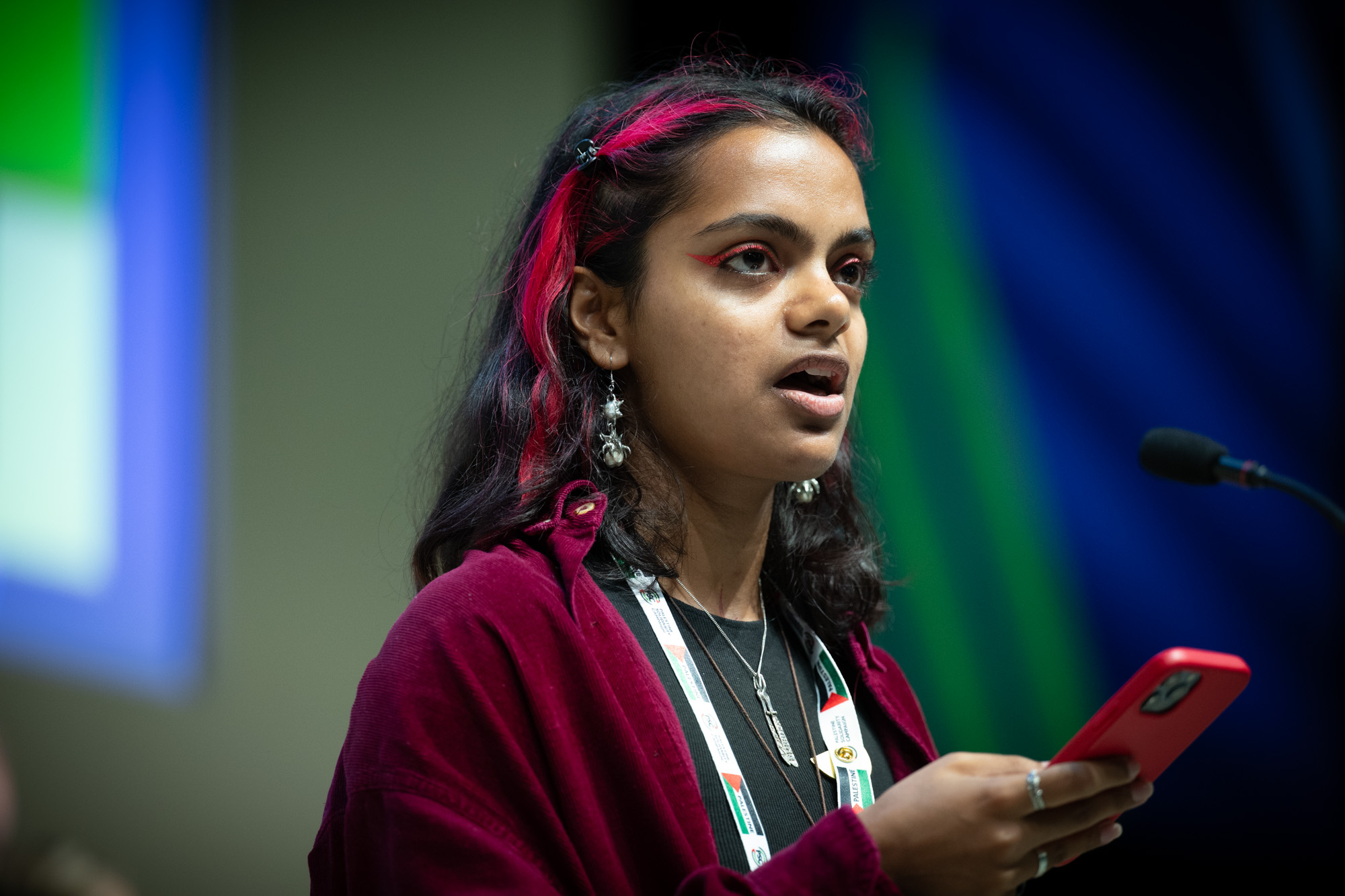
Aniqah Rawat of University of Bristol branch, a young member and first-time speaker (pictured above), told conference: “I am a child of immigrants and queer. I was raised in a Muslim family, and it is exhausting to exist in a country where the intersectionality of my identity is being exposed and vulnerable. I have received death threats and had racial slurs thrown at me in broad daylight, based on how I look, and constantly have to look over my shoulder for fear of violence when walking home at night.”
But she added to applause, “I am fortunate to live in Bristol, a city where we throw statues of slave traders into rivers, support members of our community under threat, and we make sure that the far right know that they are not welcome and never will be.”
Aniqah also spoke of how education will play a vital role in tackling the far right, which was just one reason why it was important to defend the higher education sector that is currently in crisis.
And she ended: “Those who would wish to oppress me ask me where I'm from and tell me to go back home. But this is my home, and a home should feel safe, regardless of my heritage or how I am perceived.”
Migrant workers are not the problem
Another member said: “Let us be absolutely clear. Migrant workers are not the problem. We are not taking anyone’s jobs. We are workers, we are taxpayers, we are carers, we are nurses, we are support workers and social workers. We are the people who have kept this country running, crisis after crisis. Without migrant workers, social care would collapse. We need fair pathways to settle migrants.”
And Sandra Okwara, Eastern region, said: “Behind every migrant worker is a family, a person, a human. We need to be looking at a person’s humanity before everything else.”
A delegate from the LGBT+ executive said: “For LGBT+ workers, the threat is real. Many LGBT+ members also experience discrimination because of race, disability, gender, age, religion or belief, or migration status. Those intersecting inequalities are too often targeted by far-right narratives that try to blame marginalised communities for the failures of austerity and underfunding.
“We cannot allow Reform councils or any employer influenced by their politics to roll back equality, diversity and inclusion, withdraw support from equality staff groups or cut services that LGBT+ people rely on.
“This is not a side issue… When the far-right attacks one group of workers, it weakens all of us. When we stand together. We make our union stronger.”
Trade union values are the answer
Joanne Moorcroft, North West regional convenor struck a defiant and practical note. “Without complacence, and with much to do, we believe that Reform’s coalition of support is fragile, their lead on a low percentage turnout with a five party split rests increasingly on voters who are fed up and rolling the dice, trying something new.
“The ironically and cynically named Reform UK implies change but offers a return to the failed austerity of the past, turbo-charged by the politics of division.
“We have ways of saying this directly to members. We know Reform only gets a look in because of despair and pessimism, We seek to offer our hopeful message of decent, well-funded public services to fix Britain, to beat Reform’s hateful vision.
“We do that by reaching members in one-to-one conversations, meeting them where they are, listening to what moves them, and from using our strong trade union values to offer an alternative.”
Passing the motion, the conference called on the NEC to:
- Develop a comprehensive anti-Reform UK campaign strategy leading up to the next general election and, if needed, after it.
- Evaluate and learn lessons from the work that the union undertook in the run up to the 2026 Scottish Parliament, Welsh Senedd, English local government and London borough elections.
- Support local reps who take on this work and build activist political campaign skills and capacity through the UNISON College and the self organised group networks to tackle false stories and promote positive messages.
- Work with the UNISON political fund committees to maximise the co-ordination and impact of the strategy.
- Ensure co-ordination between these campaign and UNISON’s wider campaigns on combating the broader far right and tackling racism.
- Continue to provide support to branches and members in Reform UK councils – including through recruitment and organising activity to build industrial strength.
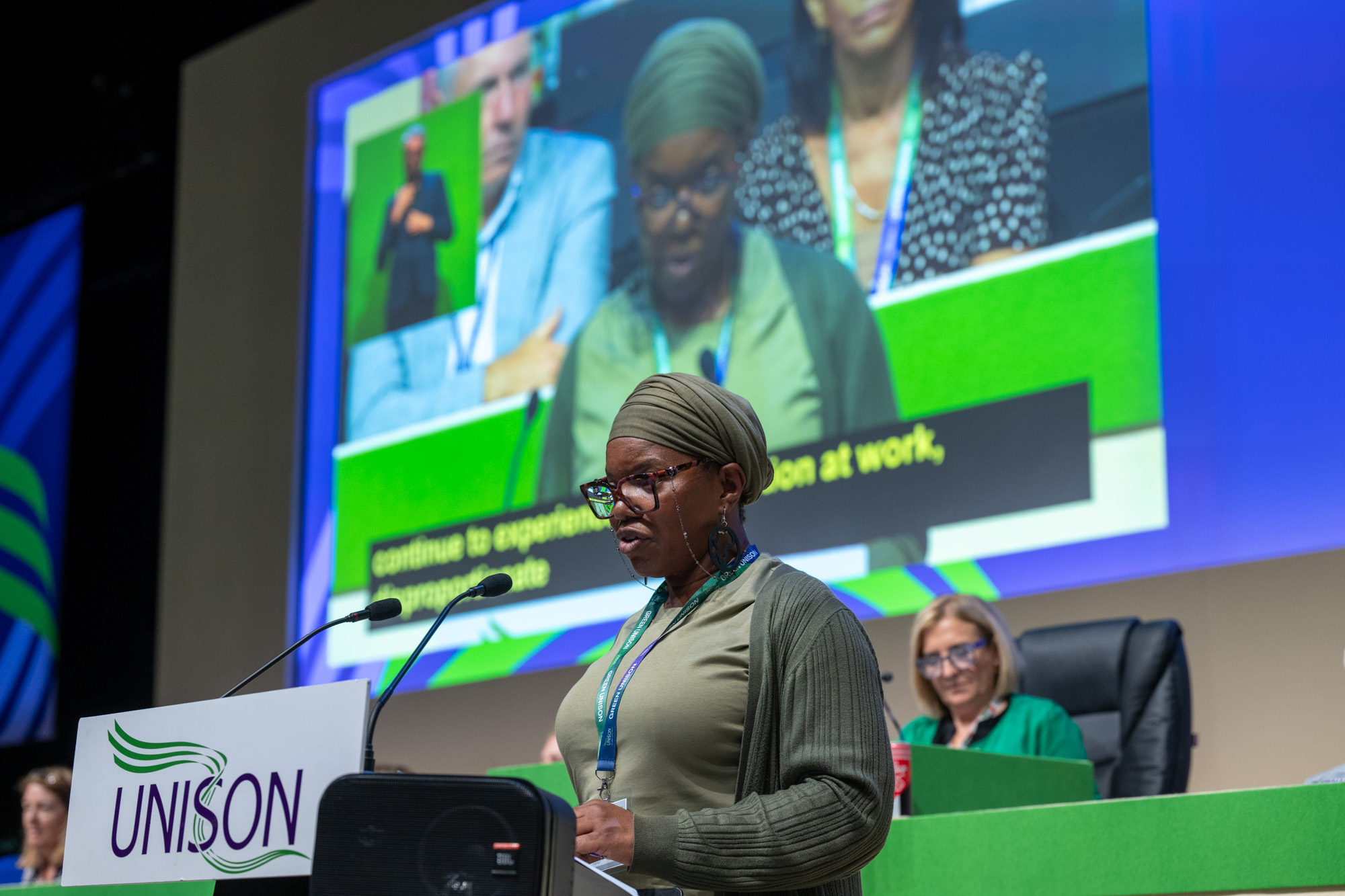
Tackling racism
A second debate this morning dealt with the fact that across the UK, Black workers and communities continue to experience higher levels of discrimination, disproportionate disciplinary action, and structural barriers to fair pay and progression.
Moving the motion, Annette Heslop of Greater London region and a member of the national Black members committee (pictured above) told conference: “Racism is becoming more visible and more vocal and racist voices are more emboldened. It is getter harder for Black workers to challenge racism and injustice.
“The language of Reform UK is frequently being used to introduce policies that restrict justice and erode the rights that trade unionists fought so hard to secure.
“The problem of racism has not disappeared, it has evolved. Racist behaviour is increasingly taking place beyond formal workplaces in work-related social settings and online platforms, like messaging and chatrooms, where workers should feel protected.
“Our anti-racism charter is one of the strongest tools we have developed, and it sets a clear framework for employers to tackle racism. But signing a charter is only the beginning. Commitments must be transformed into action. We are also working alongside organisations like Stand Up to Racism and Show Racism the Red Card. Together we deliver campaigns that educate, inform and challenge racism.
“This motion commits us to strengthening that work, to educating, to campaigning and organising our members,” Annette added. “We must build alliances and take collective action. Most importantly, this motion commits us to confronting racism wherever it exists. We cannot allow decades of progress to be dismantled. The answer is not silence. It is unity, vigilance and collective action.”
More articles like this

News
Young members at national delegate conference
Two young members attend UNISON's national delegate conference
.jpeg?w=1600&v=5564df10-21f4-4752-8d4a-3938f9a6b243&itok=mUeqVO0B)
News
UNISON elects James Anthony as President
James Anthony, formerly UNISON's senior vice president, succeeds outgoing UNISON President Catherine McKenna

News
Angela Rayner: born in Stockport, raised in UNISON
'Better quality jobs – with a stronger voice for people at work – is the solution,' said the former deputy prime minister