
Climate change is a national emergency

UNISON has embraced 2026 as its Year of Green Activity, with a host of events and initiatives aimed at enabling its members to play their role in combating climate change, as individuals and in their workplaces.
Sadly, the theme of the green fringe at national delegate conference, “climate change is a national emergency – our governments need to start treating it like one”, suggests that the powers that be are lacking the same urgency.
The Westminster government has committed to reducing the UK’s carbon emissions to net zero by 2050, compared to 1990 levels. Delegates spent an hour listening to a trio of environmental experts outlining some of the obstacles to reaching that target.
Watching the world burn
Environmental broadcaster Tom Heap (pictured above, right), who was moderating the session, said: “If our politicians or media were first responders to this [climate] emergency, I think half of them would be saying, ‘I'll get round to it later’. Others will be saying ‘there’s nothing to see here’. Some might be even adding fuel to the fire and watching it burn. The rather sad fact is this felt a little more urgent five years ago, in our national discourse, than it does now.”
Not surprisingly, one big reason for this is money. “The overall context, that we can't forget, is that the economic ecosystem, like all economic ecosystems, is kind of hostile to change. It makes money out of the way it works at the moment. And the way it works at the moment is largely fossil fuel.”
Heap added that the government and others have cited the cost of living crisis as a reason to sideline a transition to cleaner energy.
“When you ask people if they support climate action, about two thirds say yes. But another 65% say that cost of living should be the priority before climate action. Now, I suggest that's a rather bogus, either/or choice. But the political response has been dominated by the idea, recently, that caring about the environment in general and climate, in particular, is an expensive indulgence. It's something for the elite. It's something for people who can afford it.”
And that belief, he said, “is really useful fuel for populist politicians and the media that follow them.”
Loudest voices and deepest pockets
Environmental economist Angela Francis, who is director of policy solutions at the World Wildlife Fund, agreed that “the old guard is fighting not to be replaced.” While some fossil fuel companies and big agricultural companies could diversify, “clean up their act” and do well, most were choosing not to.
“Staying in the old world can seem like a really good strategy for lots of those businesses. And, unfortunately, too many companies make that choice, and they've got deep pockets, and they're buying lobbyists, media space, to sow distrust that the transition is actually the best thing for us. We saw this with the tobacco industry, lobbying against the science, and it's happening again now.
“So, it's government's job to distinguish between the overall economic interest of all of us and the interest of those it's hearing from most. The independent voices of academics and civil society have to be the ones that are heard, because the biggest incumbents have got the loudest voices and they are not lobbying for change.”
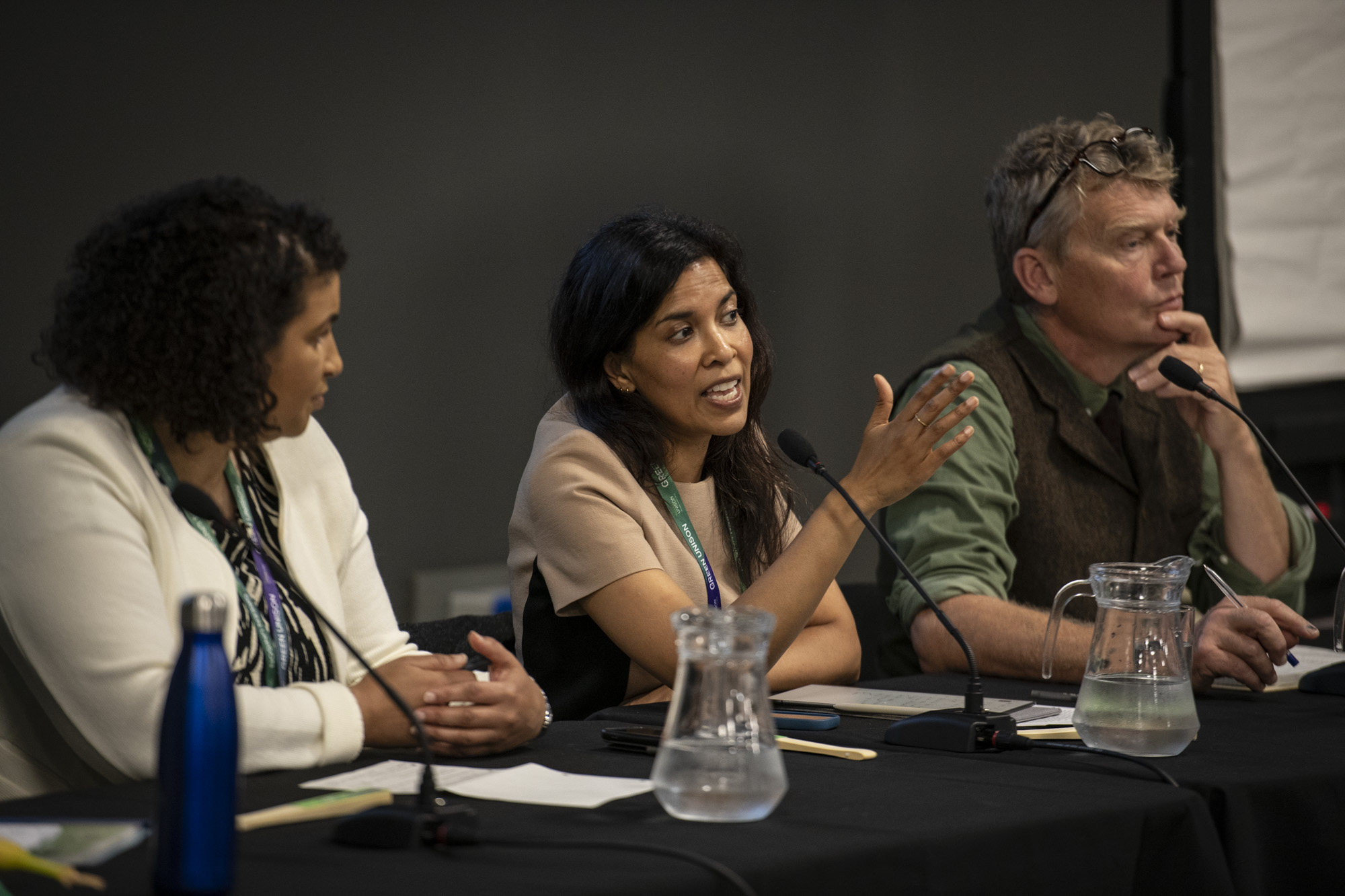
With regards to the cost of living debate, climate change lawyer and campaigner Tessa Khan (above, centre, with Angela Francis and Tom Heap) said that the reality was that a dependency on fossil fuels was the chief problem – with half of the recessions since 1970 caused by increases in fossil fuel prices.
In contrast, she said, “an energy system that's based on renewables offers countless, obvious economic advantages over one that runs on fossil fuels.” Among these, sun or wind “is free forever”, the technology for renewable-based power systems has sharply declined in recent years, renewable energy has far greater efficiency than fossil fuel.
While there have been positive initiatives from Westminster, for example its Warm Homes Plan, designed to upgrade up to five million homes by 2030, and its plan to create almost half a million clean energy jobs, Khan said that both these ambitions needed to be backed by more upfront investment. “None of this is impossible, and the rewards on the other side are enormous.”
Making the transition affordable
Among contributions from the floor, delegates raised their concerns over the parlous state of the water industry and the environmental impact of artificial intelligence. And one repeated the concern that the poorer members of society would be hit by domestic costs of climate action, such as heat pumps.
“I think this has to be the central preoccupation that we put to the government,” Tessa Khan said, “which is how to make sure that transitioning away from dirty energy is affordable for everyone, including people on lower incomes.
“You know, the market is already going some way to addressing that. Electric vehicles are now at cost parity with the internal combustion engine cars. We're also in an era where you can go to a Lidl and buy plug-in solar panels for your balcony, which you can just plug straight into your wall – free energy basically – and start to bring your energy bills down that way.
“But heat pumps are still expensive. The government's got to make those grants readily available and at the level that actually brings down the upfront costs of those technologies… We need to agitate for fairness to be absolutely central to the way that this entire project is delivered across the country.”
As for the battle against the voices opposed to climate action, UNISON senior vice president James Anthony (main picture, left) told the room that the union has been addressing this, as part of its Year of Green Activity. It’s produced an independent report from the Labour Research Department, on how to counter some of the right and far right arguments about climate. And it is lobbying government to make sure that it recognises that climate change does constitute a national emergency – and responds accordingly.
“In our last survey, 90% of our members were concerned about the impact of climate change,” he said. “And it's really important for us as trade unions that we have a voice at the table as these huge transformations are implemented.”
More articles like this
News
UNISON joins campaign to move away from fossil fuels
The union joins non-proliferation treaty as Christina McAnea says there ‘must be a fast, fair transition away from oil and gas’

News
Young members at national delegate conference
Two young members attend UNISON's national delegate conference
.jpeg?w=1600&v=5564df10-21f4-4752-8d4a-3938f9a6b243&itok=mUeqVO0B)
News
UNISON elects James Anthony as President
James Anthony, formerly UNISON's senior vice president, succeeds outgoing UNISON President Catherine McKenna